
TREE has become a primary post and colour grading facility in Japan, evolving over 20 years through strategic partnerships, the expansion of its grading suites and, most recently, the introduction of Baselight M.
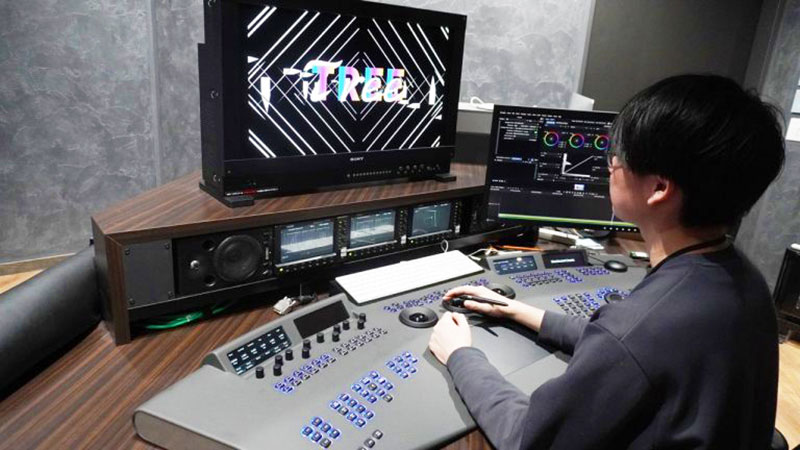
Over the last 20 years, TREE Digital Studio has established itself as a primary post-production and colour grading facility in Japan, evolving through strategic international partnerships, the expansion of its grading suites and, most recently, the introduction of Baselight and a dedicated screen grading room in 2026.
Senior Colourist Yusuke Adachi said, “Our studio was originally established through partnerships with Company 3 and later MPC, and over time we have continuously expanded our grading suites and workflows to support more sophisticated productions.
“Within TREE’s post-production division, Digital Garden, the colour department handles grading, finishing and workflow development across many types of productions – from nationwide TV commercials to international films. In 2026, the introduction of Baselight and the screen grading room further strengthened our ability to deliver cinematic projects to high creative and technical standards.”
From On-Set to Post
Yusuke Adachi originally studied cinematography at the College of Art, Nihon University, where he focused on camera and lighting with the goal of becoming a director of photography and gained on-set experience as an assistant. However, during a colour grading course, he discovered a strong interest in working with light and colour, which led him to pursue a career as a colourist.
“After graduating, I joined TREE Digital Studio as an assistant, where our collaborations with Company 3 and MPC/The Mill gave me valuable technical training from experienced colourists, particularly in interpreting light and controlling colour,” he said.
“My background in cinematography, combined with working alongside international colourists, has taught me the importance of maintaining a DP’s perspective when grading. At the same time, I aim to reinterpret and shape colour and light to bring out the full potential of the original footage – I believe this approach is essential to strong results ingrading.”
Colour, Contrast and Emotion
Katsuhiro Naganuma, an assistant colourist, first became interested in colour grading while studying at the College of Image Arts and Sciences, Ritsumeikan University, where he gained hands-on experience with systems such as Baselight for Avid.
He said, “I was particularly drawn to how colour and contrast could shape the emotional impact of an image and influence visual storytelling. I joined TREE Digital Studio in 2023 as part of the Digital Garden colour department, working as a colourist assistant across projects ranging from commercials to Netflix productions and music videos. Supporting experienced colourists on these productions has allowed me to deepen my technical understanding while developing my own creative approach to grading.”
Today, he is gradually taking on projects as a colourist himself, particularly music videos and web commercials, and continues to build up experience and skills through collaboration with the team at TREE.
The Move to Baselight M
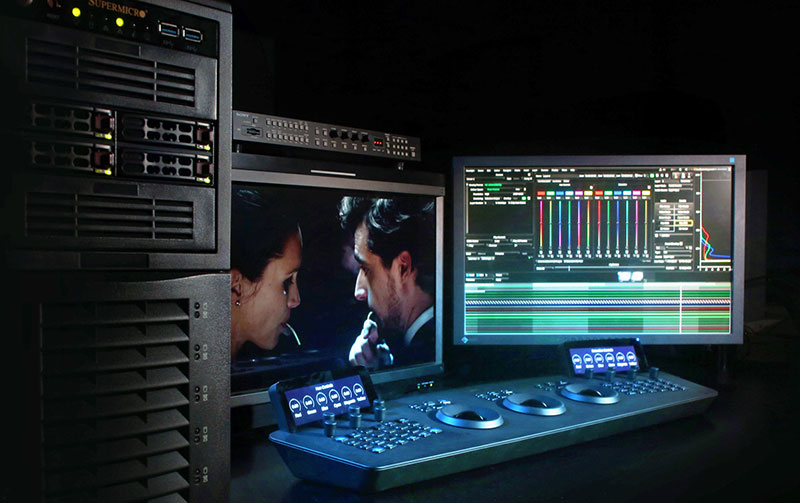
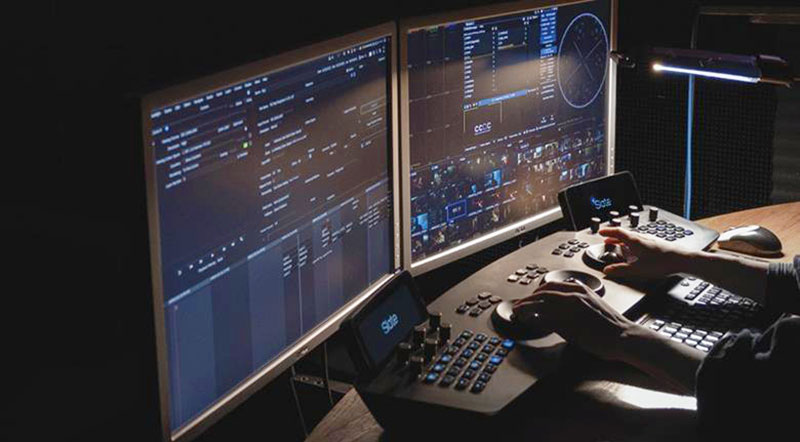
Yusuke Adachi said, “A key factor in our decision to invest in Baselight M was the ability to integrate the system into our existing Mac Pro setup, which reduced the cost and complexity. Since our DaVinci Resolve workflow was already well established on this infrastructure, adding the Baselight software and the Blackboard Classic control panel was fairly simple.
“But above all, we wanted to improve efficiency across departments—particularly through Baselight Linked Grade (BLG) file workflows. It also meant taking a step forward in our grading capabilities from a technical perspective.”
BLG is a small, portable OpenEXR data file used to create, transfer and review looks. Looks can be exchanged with all FilmLight systems – Baselight, Daylight and Baselight Editions – and applied through grading and look development, dailies and through editorial within Avid, and VFX with NUKE and Flame. These applications accurately render the BLG look through a GPU renderer.
Systems such as the full Baselight TWO traditionally require a high initial investment, which can be a barrier to adoption. “In our case, the fact that Baselight M runs on macOS, combined with its lower upfront cost through a subscription model, made it a more accessible option and a key factor in our decision,” Katsuhiro Naganuma said.
Across the Team
The Digital Gardenr team at TREE is structured mainly around colourists and colourist assistants. Although on short-form projects such as commercials, fixed teams are not usually assigned, on larger projects like feature films, they establish dedicated teams, which helps avoid errors and maintain a high level of quality.
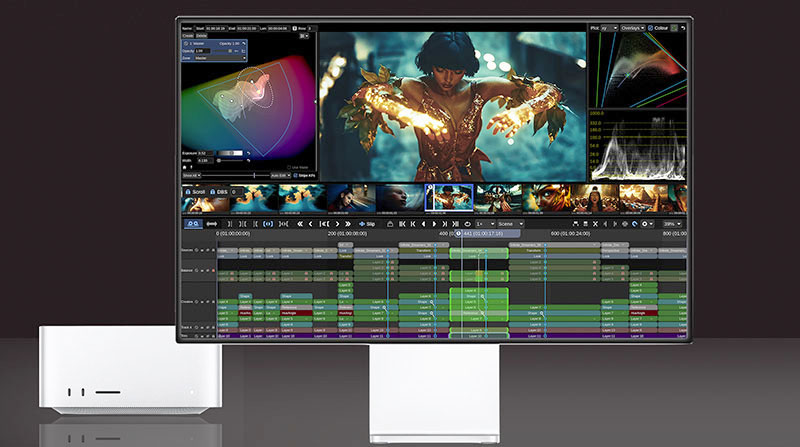
“Since the introduction of Baselight M is still relatively recent, we have not yet utilised it to the same extent as DaVinci Resolve,” said Yusuke Adachi. “But its unique approach to colour and colour space management has resulted in valuable daily learning opportunities for us, both creatively and technically. Our immediate goals are to increase the number of projects handled on the system and to further strengthen pipelines with composite teams using BLG files.
“As we mentioned previously, working with Baselight on macOS was a major advantage for us and significantly lowered the barrier to adoption. Although we needed some time to adjust from our previous tools, we were impressed by the wide range of features and how naturally it handles footage. In particular, Base Grade has been very useful for establishing the initial grade, while X Grade and Chromogen are powerful tools that allow us to achieve the precise looks we envision with a high degree of flexibility.
Baselight into the Workflow
Katsuhiro Naganuma’s initial interest in Baselight was its scene-referred workflows, including ACES. He said, “Compared to DaVinci Resolve, one of Baselight’s key strengths is its consistent awareness of the working colour space, with tools that adapt throughout the grading process.
“Then for look development, features like Edit Modulation have been particularly valuable. The ability to precisely target luminance or saturation ranges within curves gives you a level of control that, in Resolve, often requires combining multiple tools such as curves and keying. In Baselight, the colour space–aware approach helps avoid artefacts or visible boundaries, resulting in more consistent and reliable adjustments.”
In the workflow they have developed for commercials, grading is usually followed by online finishing in Autodesk Flame, where final deliverables are produced. On tight schedules, the online team sometimes need to start directly from camera originals using LUTs exported from the grading session. “However, since LUTs do not include effects or secondary corrections, this has been a limitation for both the colourists and the online team for some time. FilmLight’s BLG files are a promising solution to this challenge.
Media Handling
“From a media handling perspective, Baselight has also helped deepen our understanding of image workflows,” said Katsuhiro Naganuma. “In Resolve, we could import most timelines or media without much consideration. With Baselight, however, the conform stage requires greater attention to factors such as frame rate relationships, source colour space and resolution settings. As a result, the software naturally encourages assistants to build a stronger technical understanding of image processing and workflow fundamentals.”
When grading darker scenes, Yusuke Adachi finds the Pivot feature particularly useful for fine-tuning detail with greater precision. “I often develop looks in close collaboration with the DP, who say that their creative intent translates directly into the grade, very easily. It gives me a greater level of responsiveness, different from what we had used before,” he commented.
“We also used Hue Shift to control sky colour, and I was impressed by how well the image held up – even with fairly strong adjustments, there was very little image breakdown. Because we’re still getting familiar with the system in day-to-day use, we’re trying to improve media organisation within layers, as well as gain more control over overall working speed.”
The Precision of X Grade
For Katsuhiro Naganuma, X Grade is extremely powerful. He said, “There are times when primary grading or the base look alone is not enough to achieve the desired colour for elements such as clothing. Being able to quickly experiment with colour adjustments without keying is a strong advantage. I’m also impressed by how it keeps the white point anchored by default. Even with fairly extreme adjustments, the colours shift in a very natural way, which is remarkable to see.”
Another interesting aspect is the ability to adjust exposure within X Grade while maintaining image integrity and minimising artefacts. Because the tool helps prevent image breakdown, the artists stay more focused on the creative process. He commented, “We’ve also received feedback from cinematographers who were surprised by how straightforward X Grade is to use.”
When advising aspiring colourists in Japan, Yusuke Adachi says that he believes inspiration for a strong look can come not only from films, but also from photography, painting and everyday life. Constant communication with people and, of course, clients is essential as well. “I’m still learning day by day, but in this world of light and colour, where there is no single right answer, I hope we can continue to explore and grow together.” www.filmlight.ltd.uk