


Spark Story is a rapid virtual shot system using live 3D storyboarding to help filmmakers and teams start previs and pre-production for new projects well before the script is complete.
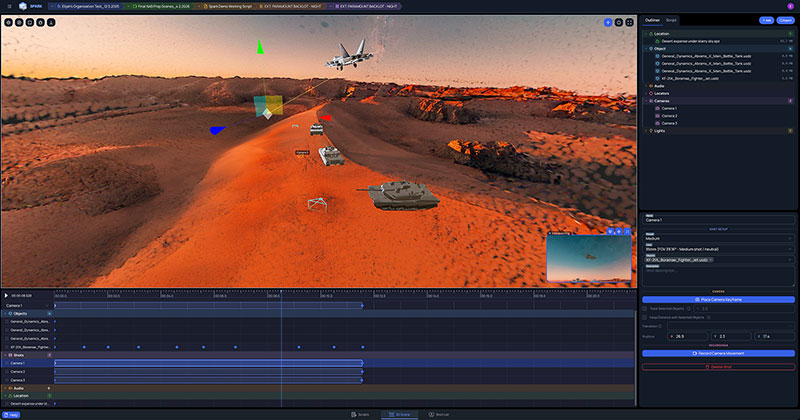
Spark Story is a rapid virtual shot system developed by Lightcraft Technology,using live 3D storyboarding to help filmmakers and teams start previs and pre-production for new projects well before the script is complete. Eliot Mack, CEO and founder of Lightcraft Technology, believes that seeing a project in 3D is too important to leave until post-production. Using Spark Story as a set of accurate, live 3D storyboarding tools, users can start visualising story elements in 3D as soon as their ideas come to mind.
Spark Story builds scenes around realistic digital environments – scanned, or prompted and generated from AI models – physically correct motion and existing camera and lens models. With this realistic foundation, directors, DPs and producers can feel more confident that their early decisions can proceed on set.
Because Spark Story’s tools represent familiar steps in production, filmmakers will recognise their functions and how they work between the 3D visualisation project; the database of assets, locations, cameras and lenses; and the screenplay. At its core, Spark Story is a real-time script editing and breakdown tool that people can use to work collaboratively, and turn partial ideas into a full screenplay.
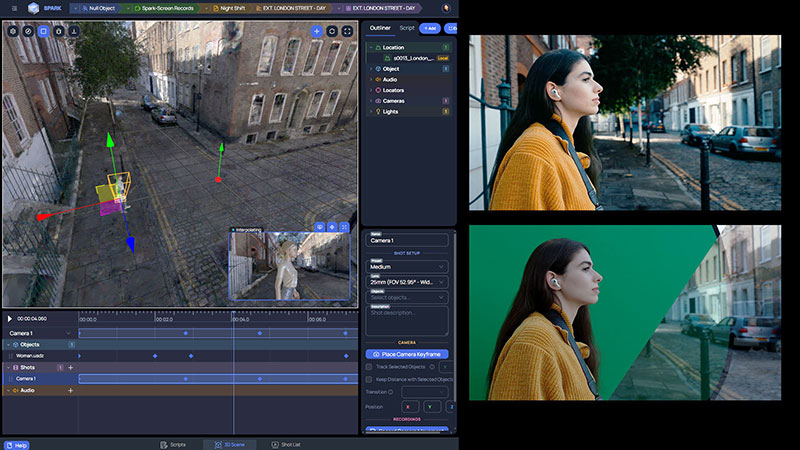
Linking story to camera.
Accurate, Living Storyboards
The starting point of each project is the script, which the user can import and edit, or write from scratch as they work through scenes. The script is the true backbone of the Spark Story application, which keeps the filmmakers in control. From there, the user selects a scene and then starts building it out in 3D in the application’s 3D viewport – bringing in locations, Gaussian Splats and USD assets to block out the production. Cameras are placed in the 3D scene, and automatically generate shot list entries linked to the script, settings and framing of a shot.
Adding cameras is where Eliot believes Spark differentiates itself from other types of previs. “Because you have your script close to hand, you can readily select a passage from the script, assign a camera to it and create shots for that passage, moving the camera around the scene into position for specific shots. Further cameras can be added to the sequence, and meanwhile Spark Story keeps track of how many cameras have been created and where, keeping the production very organised.
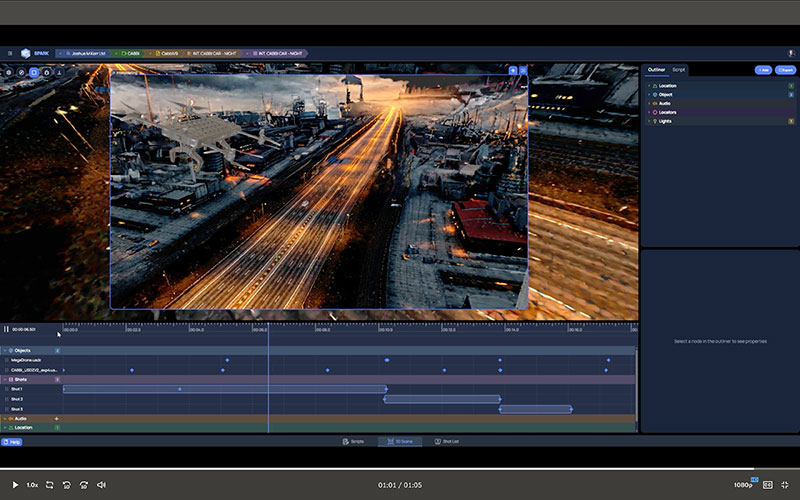
Shot previewing
Animating cameras is important as well, and is done from the timeline at the bottom of the UI. Once the user has created and animated the project’s shots, they can be assigned to a shot list, ready to take on set.
The Gaussian Splat render method is used here because, unlike 3D meshes, it renders volume data directly without first converting the data into surface or line primitives, saving time and compute power. 3D data is represented as a collection of points (with Gaussian distributions), rendering surfaces continuously and volumetrically over possible functions that fit a set of points.
Mobile App Integration
An important feature is Spark Story's integration between the browser and their Spark iOS mobile app, allowing global teams to work together live with very fast interactivity, using scripts, Gaussian Splats, imported USD assets, camera motion and so on.
The Spark iOS app allows anyone to participate in the shot capture process from any location. The same 3D environment, characters and objects that appear in the browser will be accessible via a user's iPhone or iPad. They can then record their take, which is immediately observable by all parties currently in Spark Story. Spark will then add it to the project shot list for future consideration and planning. Any scenes they create can also be pushed to their Jetset app, which is designed for blue and green screen virtual production tracking, metadata capture and post production automation down the road.
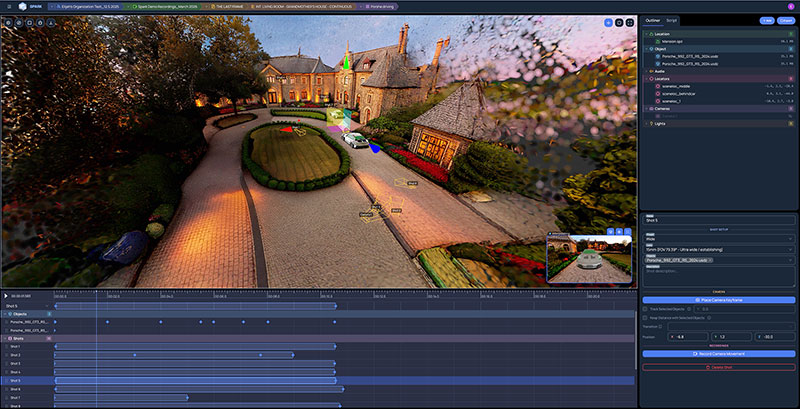
A camera view
The Jetset app serves three main functions. One is to read in assets – USD files from 3D software, 2D or panoramic stills or mp4 videos – and then play back animated 3D scenes and characters. Jetset’s Scene Locators are used to anchor specific parts of a live action scene to points in the virtual environment, establishing and maintaining these 3D relationships throughout the tracking and compositing stages.
Jetset includes integrated camera tracking for use on set or on location or on a soundstage, tracking handheld and stabilized cameras, dolly and crane moves. Its blue and green screen keyer employs AI keying, ‘infinite greenscreen’ for 3D tracked extensions, and automatic depth compositing. Jetset automatically captures both the camera original video, the real time composite, a depth map and camera tracking metadata.
"Every team can see the story before they step on set, regardless of the production’s resources or team members’ experience," said Eliot. "The days of waiting until post to figure out if the story is working are over. With Spark Story, a team can go from 0 to 80% and be ready for pitching and planning much sooner. Then they can pull people in, build momentum and accelerate the shooting process."
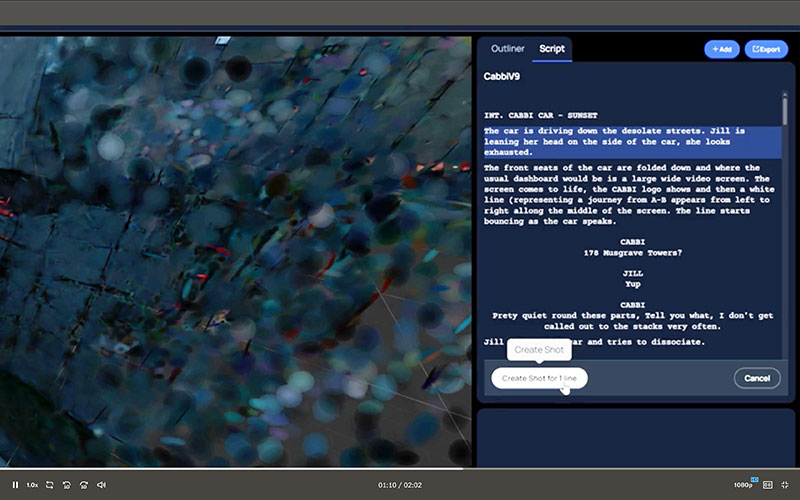
Creating a link from script to shots.
Finding Your Way Through 3D Space
Spark Story takes advantage of Apple ARKit, which was developed to build augmented reality (AR) experiences on iOS devices. In order to track the position and orientation of the device in 3D space, ARKit uses its accelerometer and gyroscope to match camera input to motion data. With this understanding of how the device moves relative to the environment, ARKit can effectively combine the data and use it to anchor objects to surfaces.
ARKit also handles scene understanding through features like plane detection, light estimation and image or object recognition. Performance optimisation is a key aspect of ARKit as well, making efficient use of the device’s GPU and CPU to balance real-time processing with hardware limitations
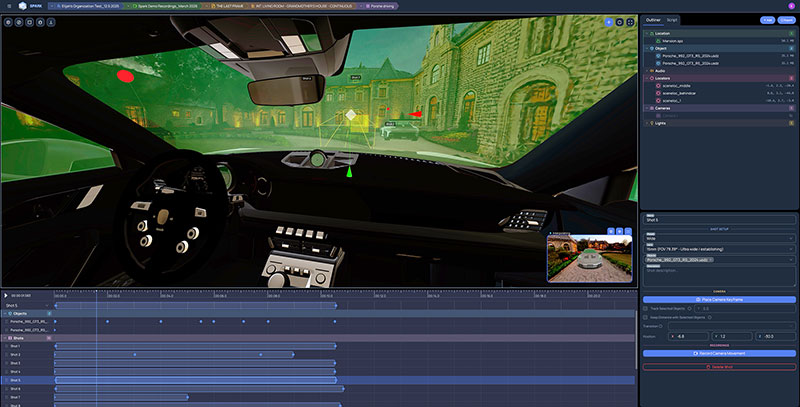
View from a car interior.
Spark Story is the first application in a comprehensive Spark platform that is still in development. When Lightcraft showed it at NAB 2026 in April, visitors had a first look at the key features – the real-time 3D shot construction, dynamic screenplay editing and integrated shot list. Eliot commented that Spark’s approach, stripped back to address previsualisation specifically, is what helps filmmakers move very quickly to production on set. Sign up here to be notified when the Spark beta program begins. lightcraft.pro
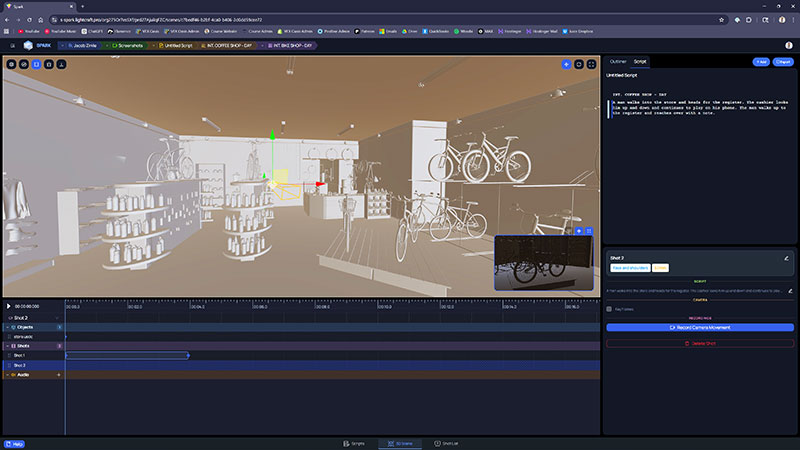
Bike room location.