


Eurovision Services chose Ateme’s software-defined frame-rate conversion to support live production and delivery workflows across COTS platforms, hybrid and cloud infrastructures.

From locations around the world, Eurovision Services delivers media and broadcast services for some of the world’s most watched live events. For decades, Eurovision Services has supported broadcasters, rights holders and content owners across the media chain from contribution and signal distribution to delivery.
Mostafa Bibak, Principal Solution Architect at Eurovision Services said his company was looking for a frame-rate conversion solution combining high video quality with the operational flexibility of software-based infrastructures. They chose Ateme’s software-defined media processing for its ability to support high-performance live production and delivery workflows across on-premise, hybrid and cloud-enabled infrastructures. “Ateme’s approach allows us to continue using our current infrastructures while supporting the evolving requirements of international live event operations,” he said.
Senior Solution Director for Contribution and Distribution Markets at Ateme Julien Mandel commented, “Premium live content requires frame-rate conversion technologies that preserve motion accuracy, image sharpness, and fine details even in very challenging sports and live event environments. By running as pure software on standard COTS platforms, our solution delivers both high video quality and the operational flexibility required for modern live event workflows.”
Built for Live Production and Delivery Environments
Designed for demanding live production and delivery environments, Ateme’s motion-compensated frame-rate conversion renders high-speed motion content while preserving image sharpness and fine details, all key of which are key requirements for premium sports and international live event coverage.
Built on a pure software architecture, Ateme’s solution enables Eurovision Services to run 84 frame-rate conversion channels on standard server infrastructures already deployed across its operations. This software-native approach enables flexible licensing models for live event operations and contributes to Eurovision Services’ transition toward IP-based delivery workflows.
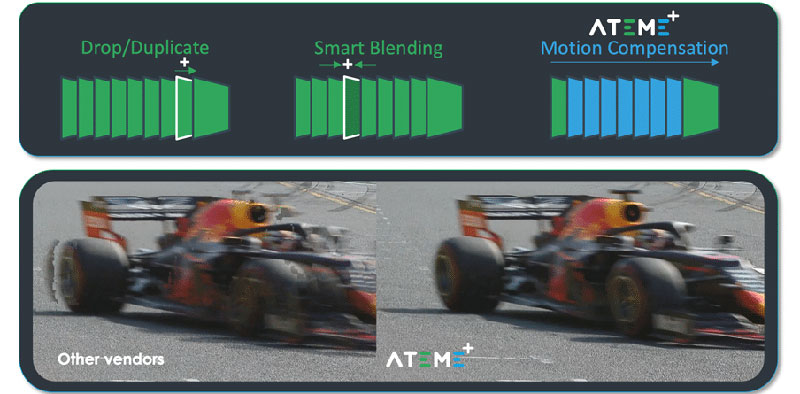
Video produced at one frame rate must often be delivered to regions using another. The challenge comes not from changing the frame rate itself, but from changing it without damaging motion perception. Though viewers may not be aware of the frame rate they are watching, they immediately notice jerky camera pans, trails behind fast-moving objects and blurred details or unstable graphics.
Re-writing Traditional Techniques
Traditionally, frame-rate converters have relied on techniques such as duplicating or dropping frames, which preserve sharpness but often introduce stuttering. Frame blending improves smoothness by combining adjacent frames, but may cause ghosting where objects move significantly between frames. Combining these approaches can reduce problems, but sudden changes in direction and complex textures still expose their limits.
Ateme has developed a motion-interpolated frame-rate conversion algorithm that analyses how objects actually move between frames and generates new frames that reflect that motion realistically. Instead of approximating motion, it relies on motion estimation and motion compensation to recreate what the camera would have captured at the exact moment required for each output frame.
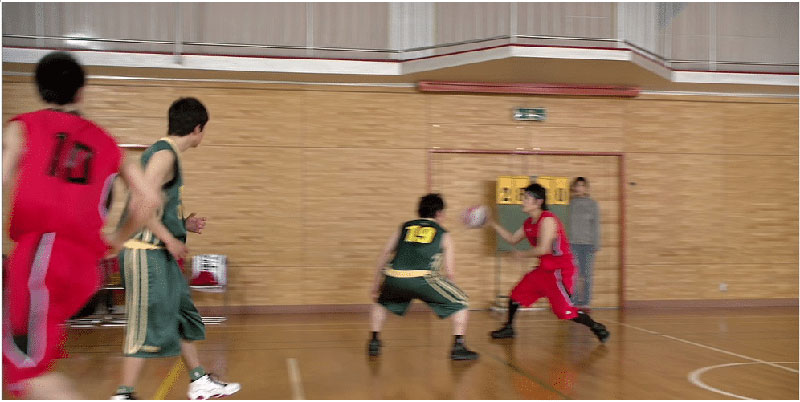
The result is smoother video and more natural motion. Motion interpolation is particularly effective in sports, where speed is constant and unpredictable. Ateme’s frame-rate conversion algorithm estimates hierarchical motion to track movement at multiple scales. It compensates for iterative overlapped block motion for precise motion handling and applies temporal inpainting to manage object appearances/disappearances and scene cuts.
Dynamic Workflows
Until now, frame-rate conversion has been tied to dedicated hardware appliances, but today, sports broadcasting is becoming more dynamic, requiring temporary channels, short-term capacity increases and quick set-up, and remote or cloud-based workflows. Therefore, Ateme adopted software-based baseband processing, separating its frame-rate conversion algorithm from specific hardware.
As well as working on COTS hardware, through Ateme+, Ateme’s pay-as-you-go SaaS, high quality motion-interpolated frame-rate conversion is available for occasional-use and event-based workflows, without affecting quality. Broadcasters can scale processing capacity on demand and align costs directly with event duration, an important advantage for modern sports media.
Furthermore, due to their full software implementation, Ateme’s frame-rate conversion technologies continuously benefit from ongoing innovation and regular quality enhancements. https://www.ateme.com/