Maxon's new release of Cinebench is updated to the most recent Redshift Rendering engine and adds support for the new NVIDIA and AMD GPUs, and M4/M5 Apple Silicon processors.
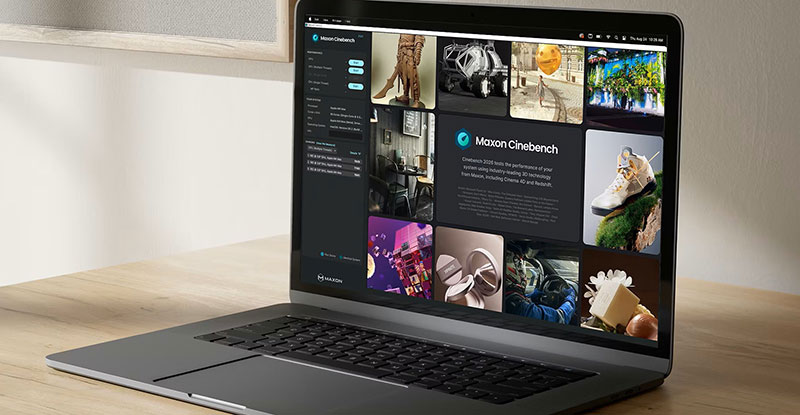
Maxon Cinebench 2026 benchmarking software is now compatible with NVIDIA's new Blackwell GPUs (5000 series) and AMD 9000 series GPUs on Windows, as well as NVIDIA Hopper and Blackwell data centre GPUs. Cinebench 2026 now supports Apple M4 and M5 Silicon processor powered systems as well.
Reviewers, hardware manufacturers and individual computer owners have used Cinebench for computer performance evaluation for some 20 years. Aligned with industry standards, Cinebench utilises Redshift, Cinema 4D's default rendering engine, to accurately assess and evaluate CPU and GPU performance using actual 3D rendering workloads.
To take better advantage of the modern hardware described above, Cinebench 2026 has been updated to the most recent Redshift Rendering engine. The new developments in Redshift also affect how accurately users are able to predict the performance they can expect in Cinema 4D 2026, based on the results from Cinebench.
Due to a new test that evaluates the performance of simultaneous multithreading (SMT) enabled CPU cores – which allows each physical core to process two or more threads concurrently – users can directly assess the performance they can gain through SMT compared to single-threaded execution.
Cinebench 2026 supports a broad range of hardware configurations, including systems running Windows x86-64, Windows ARM64 and macOS. Maxon notes that Cinebench 2026 scores cannot be compared to those of the earlier Cinebench 2024 version. With the incorporation of the Redshift architectural updates and optimised performance, Cinebench 2026 produces a distinct, accurate evaluation of modern hardware capabilities.
Cinebench 2026 is available free-of-charge from the download page on the Maxon website. www.maxon.net