

DP Judd Overton talks about shooting this kids’ comedy show on the Blackmagic URSA Cine 12K LF, relying on the camera’s flexibility and image quality to create a distinctive style and look
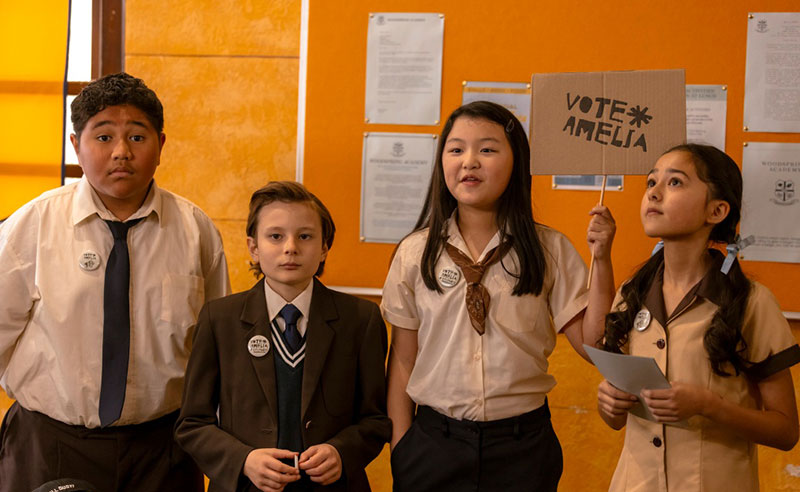
In the new children's adventure comedy series Caper Crew, produced by Australia's ABC, young Amelia Delaney is tired of playing second-best to lucky Emelia Katinkatonk, a member of the extremely fortunate Katinkatonk family. For years, she’s tagged along behind Emelia. But this year, Amelia has a plan – no more coming second. She’s ready to win, and fortunately, life has a few surprises in store.
Then unexpectedly, Amelia’s flamboyant con-artist grandmother Queenie arrives, seeking a crystalline meteorite called the Nug that crash landed in the town some years ago. The meteorite is reputed to bring luck to those who own it. However, shortly after it landed, it was lost. Queenie helps Amelia and her friends form The Joeys, a con gang dedicated to bringing the Nug home to Woodspring and – hopefully – changing Amelia’s fortune.
Since the loss of the Nug, Woodspring exists out of step with the rest of the world – not ‘old-fashioned’, but stuck in its own timeline. Set-up Director Guy Edmonds and DP Judd Overton were under pressure to give the show a distinctive style and look, while working within a set of practical constraints largely defined by the need to work with children. For instance, young attention spans are limited, calling for limited hours on set.
Producing a comedy brought other constraints. Although the show features deadpan delivery, fourth-wall asides and comical visual storytelling, performances were to remain grounded. Guy wanted to both avoid trends that could date the show, and keep his options open for stylised, cinematic composition.
Structured Production
Shooting on Blackmagic URSA Cine 12K cameras, DP Judd Overton kept the framing symmetrical whenever possible, favouring formal, centred shots. He took care to keep a little space between characters in group shots to allow for split-screen post adjustment, important for working with fidgeting children. Handheld was also inappropriate. This cinematic kind of structured storytelling required using a dolly, steadicam and locked-off shots with clear intent.
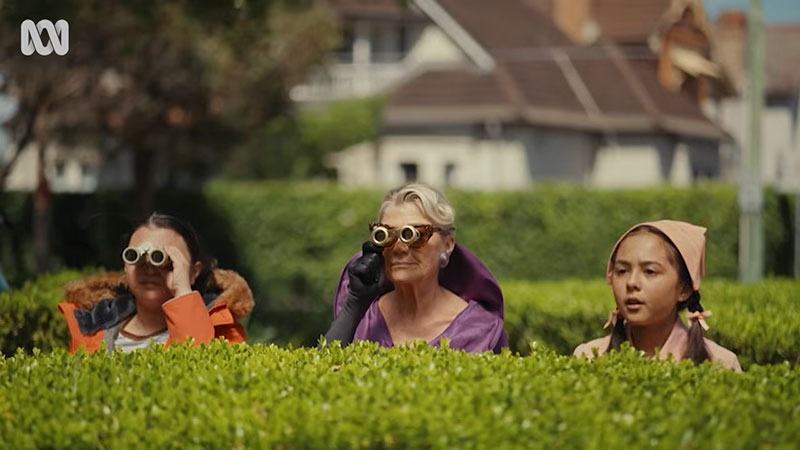
Aspect ratio flexibility was always going to be essential. Depending on key moments in the story, Judd wanted to shoot 4:3 to evoke 1990s news clips, with various post treatments applied for VHS-style nostalgia. He and Guy chose 2.39:1 widescreen for flashbacks, and 2:1 for the present day, with a slight 16mm film grain added in post.
Judd said, “We chose a number of different aspect ratios to best express the time periods of the show. The heist sequence was shot 1990s style – anamorphic on the Atlas Orion lenses at 9K Super 35. Other scenes such as a 1940s flashback are shot 4:3 in black and white.”
In the Frame in Real Time
As a director, Guy Edmonds is a hands-on, on-set kind of filmmaker. By seeking a handcrafted, storybook feeling throughout and using recognisable cinematic techniques, his crew made sure all elements – costumes, colour palettes, transitions and sound design – contribute to a cohesive result. Timelessness was an important concept. The goal wasn't only to create a visually distinct world, but to make Woodspring feel as though it had always been there, waiting to be discovered.
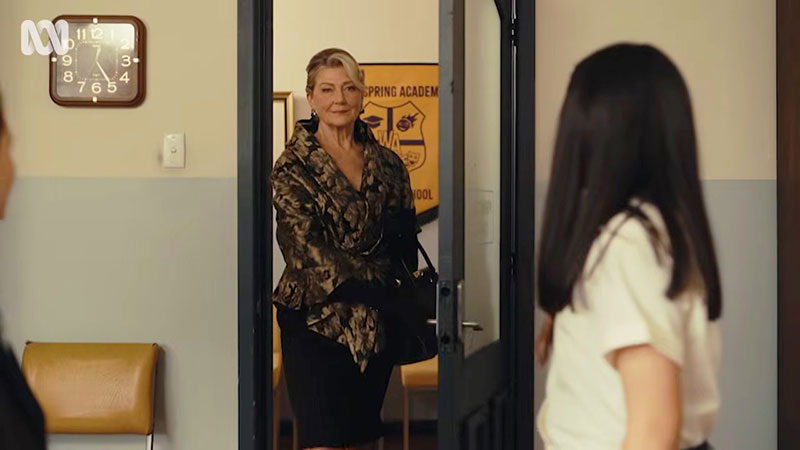
Favouring composed shots, rather than relying on cuts, the action tends to unfold within a single frame. Characters move toward or away from the camera, or across the frame in a carefully composed way, allowing comedy and story beats to play out in real time. In turn, the editing and pacing were typically deliberate, going for rhythmic momentum. Guy also liked to use doorways, windows and mirrors to create layered compositions. For a transition, for example, a door opens, pushing viewers into the next scene
Look, Feel, Colours
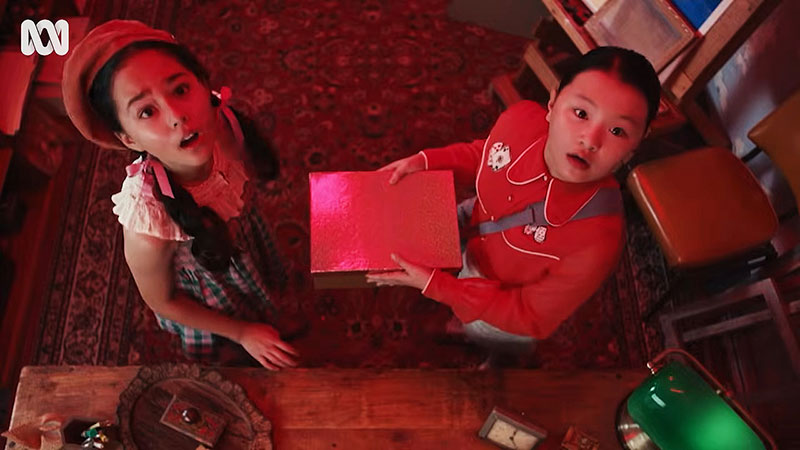
In Woodspring’s timeless, heightened world, colour helps deliver the story. As mentioned, Woodspring isn't as old-fashioned as it is a place out of time. Public spaces, signage and civic branding may still reflect the past, but buildings are freshly painted in the same colours as decades ago, and school uniform styles and colours haven’t changed in years.
Colour is used as an identifier. The leading Katinkatonk family dominate through the yellow colours in their clothes, belongings and house interiors. Amelia Delaney’s family appear in harmonising single-palette colours as well. Queenie the grandmother looks out of step with them when she arrives but over time, her costume's look evolves to ultimately unify her with the family palette. In order to control and monitor colour while on set, the production’s colourist Yanni Kronenberg created a LUT to refer to. To keep track of looks on set, the camera output was triggered to feed into
Capturing Quality at Multiple Resolutions
The URSA Cine 12K’s camera sensor was developed to allow users to capture images of a consistent, high quality at a resolutions ranging from 4K to 12K. Built with larger photo-sites on the original 12K RGBW Super 35 sensor, it achieves 16 stops of dynamic range. The RGBW architecture comprises equal amounts of red, green and blue pixels, optimising the sensor to maintain colours and capture more detail at all resolutions. Also, in-sensor scaling means recording at all resolutions is possible without cropping.
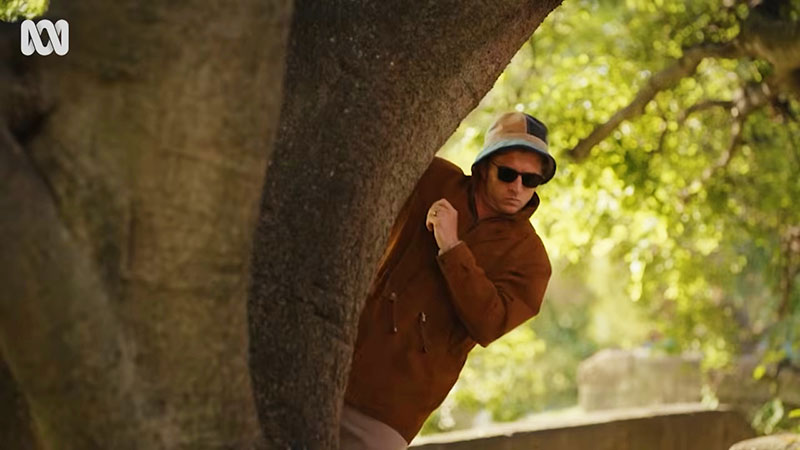
These characteristics gave the crew a large margin of flexibility on set in terms of aspect ratios, lenses and deliverables The full, large format sensor area of the 12K LF gives a 3:2 open gate image. Judd could use this large sensor area to shoot anamorphic and deliver in the different aspect ratios. URSA Cine also has an interchangeable lens mount for productions that need to switch between PL, LPL and EF lenses.
He especially liked shooting Blackmagic RAW, which captures and preserves the quality of the camera’s sensor data. The RAW files store camera metadata, lens data, white balance, digital slate information and custom LUTs – all of which encourages consistency of image on set and through post production.
The user can apply and lock a constant quality option, while allowing compression to adapt, matching the detail of the scene. On the other hand, the constant bitrate encoding option will record the ‘best possible’ images keping the file size predictable and consistent. For very high quality recording, URSA Cine records to the Blackmagic Media Module 8TB.
A Few Special Requirements
The 1st AC Juliet Young working with Judd said, “We shot at the constant bitrate of 3:1, with full frame resolution of 3:2. We were mostly recording 4K, but sometimes bumped this up to 8K for selected wide shots and 2-shots [two characters in one frame] to give us the option to zoom in and blow them up later.
“For certain sequences, we shot anamorphic, and because the Atlas Orion anamorphic lenses we chose happened to be super 35, we were also using the 9k super 35 mode.”
Judd said, “We wanted to shoot the highest quality possible to utilise every nuance the 12K Cine LF has to offer. For recording media, we chose to use the CF card module instead of the 8TB module because CF cards were going to fit more easily into the regular workflow of our post production team at Spectrum Films. Setting up dual cards is possible for shooting at the highest speeds, when the write speed of a single CFExpress card is not enough to handle what the camera can output.”
There was actually a need for high frame rates in a few shots. Interestingly, achieving higher frame rates on the CF cards took a bit of research. Juliet said, “We did some reading and testing and came up with a ‘cheat sheet’ of maximum frame rates for both single and dual cards. Another option might have been to shoot to the 8TB Blackmagic drives. But, for the limited amount of super high speed we needed, in the end we opted to stick to single card recording and keep to a maximum of 150 fps in 4K 2.39:1 mode. www.blackmagicdesign.com