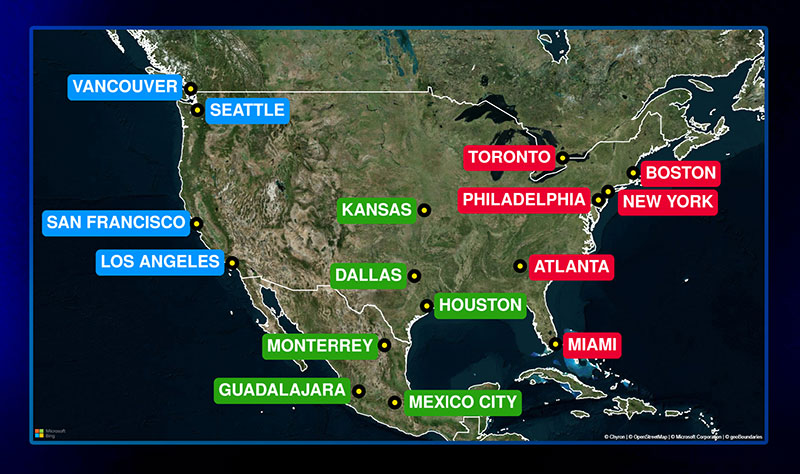


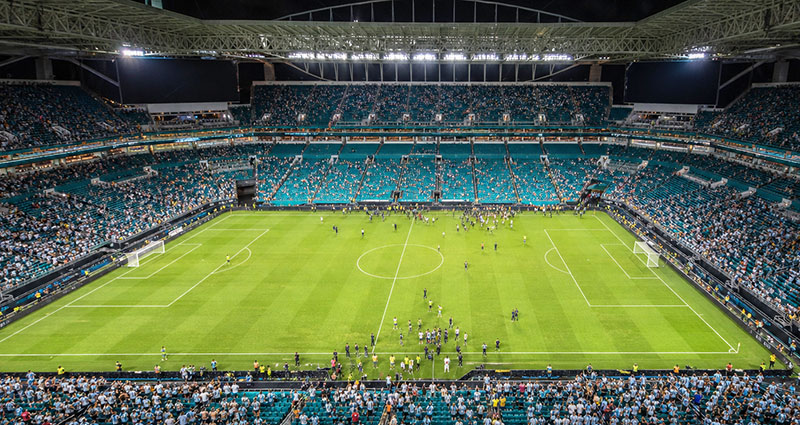
Paul Davies at Yospace tells how Argentina's last-32 meeting with Cape Verde in the Miami heat, one of the World Cup’s standout matches, gave advertisers an unexpected lift.
Paul Davies, Head of Marketing, Yospace
Argentina's last-32 meeting with Cape Verde in the Miami heat has been widely regarded as one of the standout matches of the World Cup. On one side were the reigning champions and world number one; on the other, tournament debutants from a nation of just over half a million people, who twice drew level with the holders and took them all the way to the 111th minute of extra time. Cape Verde made history simply by being there, and then very nearly rewrote it altogether.
Yospace is collecting streaming and advertising data from 14 OTT rights-holders worldwide throughout the tournament, intending to show how in-match events shape streaming audiences and advertising opportunities. In this article, we're analysing Argentina’s 3-2 victory against Cape Verde, a match in which an unmissable favourite and a fearless underdog combined to keep the audience growing deep into extra time.
Pre-match and First-half Audience Growth
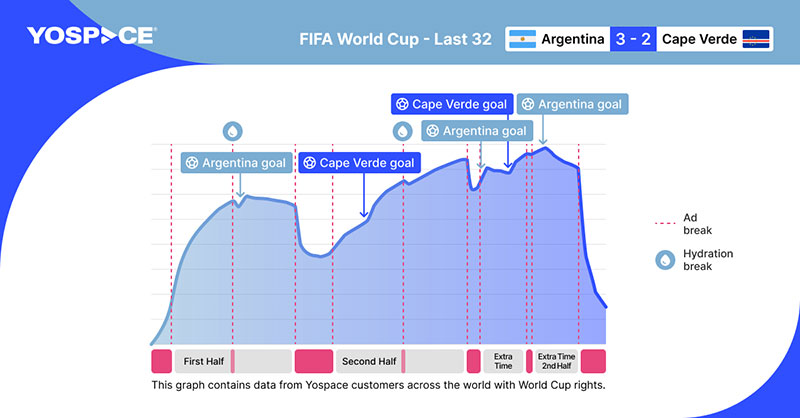
Argentina’s matches with Lionel Messi are appointment viewing, and the viewing trends reflect it. The audience climbed sharply ahead of the match, with the usual pre-match ad breaks benefiting from more eyes as the curve continued to rise steeply towards kick-off. Growth continued through the opening half hour, given a lift by Argentina's opener in the 29th minute, which arrived shortly after the first-half hydration break.
Hydration breaks are a feature new to this tournament. The mandatory three-minute pauses midway through each half create an additional ad opportunity that didn't exist at previous World Cups, while being short enough to limit audience drop-off. The first-half break here produced only a brief dip before the curve resumed its climb.
Cape Verde's Equaliser Accelerated Audience Growth
The half-time whistle brought a familiar pattern – a pronounced dip as viewers stepped away, affecting ad-break audiences, and a recovery once play resumed. From there, the underdog story blossomed with a 59th-minute equaliser for Cape Verde.
The viewing curve grew considerably steeper as word spread that the team had equalised with the reigning champions. Ads served during the second-half hydration break were viewed by a rapidly growing audience that barely dipped, making it one of the most valuable ad breaks of the match. The audience then continued climbing all the way to the end of normal time, achieving a level far above the first-half plateau. In a typical match, the audience peaks around the hour mark and declines gently thereafter; here, with Cape Verde matching one of the game's superpowers blow for blow, it was still growing at the 90th minute. This resulted in the most watched ad break of the entire match.
A Second Half Audience Peak
The end of normal time meant a break and the usual dip in viewership this entails, but viewership recovered immediately once extra time kicked off.
Argentina retook the lead in the 92nd minute, a development that was followed by a drop in viewership as many fans assumed the match had already been decided. Cape Verde proved them wrong with another goal later voted the best of the round of 32, a fitting signature for their first tournament. Viewers quickly tuned in again to see how Argentina would respond. In the second half of extra time, Argentina sealed the deal with their third goal.
The match’s timing is worth unpacking. Peak audience numbers were reached more than two and a half hours after kick-off, at a point on the match clock that most fixtures never reach. Wherever in the world viewers were watching from, they stayed, and kept joining, far beyond the length of a normal match. Extra time also delivered its usual commercial bonus – roughly 35 minutes of unplanned premium content, additional audience for the ad break at the end of the 90, and an extra break at the culmination of extra time, all served to an audience that had grown rather than shrunk. Cape Verde's refusal to be beaten inside 90 minutes directly created that inventory.
The final whistle brought a customary sharp drop-off, with the closing ad breaks served in quick succession as the post-match coverage wound down.
Handling the Demand on Ad Technology
A match like this is unforgiving on the technology behind the stream. Extra time cannot be scheduled in advance, hydration breaks move with the referee's whistle, and a five-goal epic can create high-value ad breaks far beyond the expected timing of a football match. Advanced prefetch, working alongside Dynamic Ad Insertion (DAI), ensures every one of those unpredictable opportunities is monetised seamlessly at scale, whether the audience is arriving for kick-off or peaking in the 111th minute.
By pacing ad requests slightly ahead of a break, rights-holders give the adtech ecosystem more time to respond, enabling demand partners to compete without being overwhelmed by sudden traffic spikes. This helps deliver the highest technical fill rates and maximise the value of each ad opportunity.
Cape Verde left the tournament having made history and won admirers around the world, while Argentina knew they were pushed every inch of the way. For rights-holders, the combination of a team you cannot miss and an underdog beating the odds produced an audience that kept building to the final act, and an evening of inventory that considerably outperformed a standard 90-minute match. www.yospace.com