

Seeking precision and clarity across dialogue, music & effects, City Springs Theatre deploys spatial audio, built with tracking on a Dante network, used to place voices in time and space.
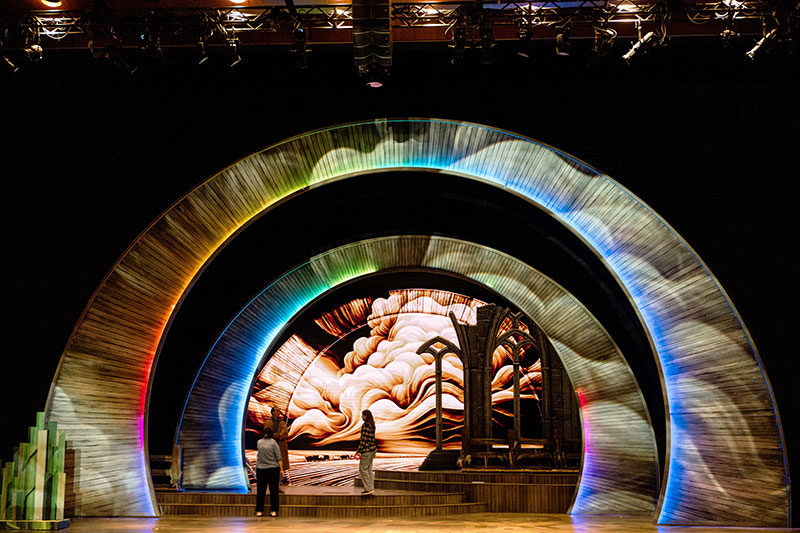
City Springs Theatre Company, based in Sandy Springs, Georgia, produces four large-scale Broadway-style musicals each year. All productions are staged at the Byers Theatre, a 1,070-seat venue located within the Sandy Springs Performing Arts Center.
The concerts, theatrical shows and other live events demand high performance and absolute reliability throughout the audio chain, from microphones and instruments to processing and out to the amplification, monitoring and recording systems.
Sound in Time and Space
City Springs’ lead sound designer Anthony Narciso has wide professional experience in theatre including his work as a member of United Scenic Artists, Local USA 829, IATSE labor union, and as a board member of the Theatrical Sound Designers and Composers Association. For his theatre's production of The Wizard of Oz, he approached the project “as if we were doing a tour”, referring to the lack of permanent infrastructure. He created a self-contained sound system that made use of the static venue as an immersive, story-driven soundscape.
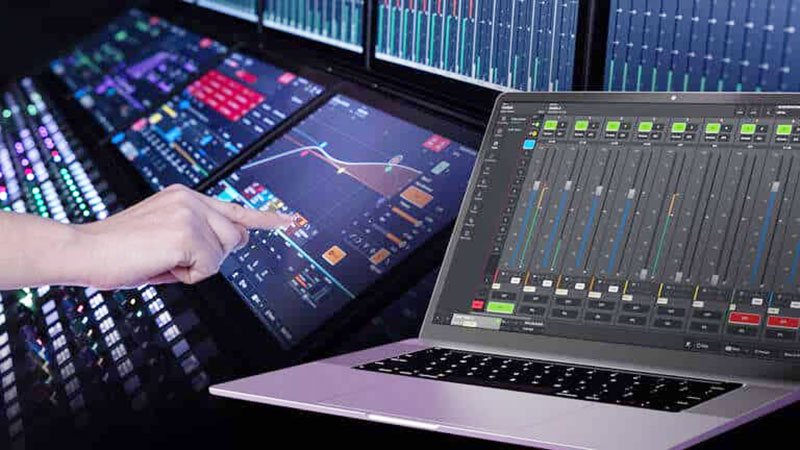
The large cast, including a child ensemble, demanded precision and clarity across a complex mix of dialogue, music and effects. To meet this challenge, the design centred on a Dante-enabled TiMax SoundHub, TiMax TrackerD4 tracking and a Dante network backbone to connect microphones, consoles, processors and amplifiers. As Anthony described it, “We deploy a spatial audio system built with tracking that allows voices to be placed in time and space.”
TiMax SoundHub is a spatial audio platform for immersive audio show control with tools for audio playback and editing. It includes functionality for spatialisation, localisation and system processing. The TiMax TrackerD4 automates localisation by tracking mobile subjects and performers. Used together, the equipment supports a feeling of immersion and engagement, and enhances impact.
Clarity Out of Chaos
Producing The Wizard of Oz posed both artistic and logistical challenges. The installation period was just over a week, half the normal time. “We normally have about 12 to 14 days to get a show up, but we had only about a week to put this one up,” Anthony said.
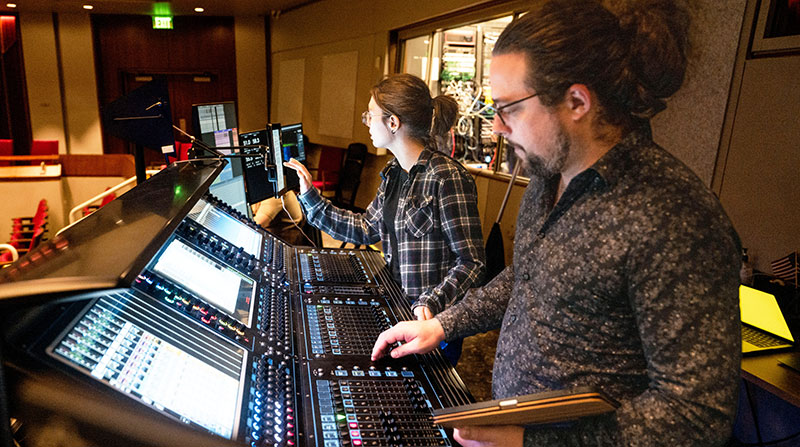
From a creative standpoint, the show demanded storytelling through sound that could balance orchestral grandeur, environmental effects and vocal clarity. “The main goal for me is bringing clear sound to cacophonous moments,” Anthony said. “During the tornado sequence, for instance, while we have to be effectively swallowed by a tornado... we also have to hear the orchestrations clearly.”
Achieving that clarity required precise control of placement, movement and intelligibility – made possible through a robust, flexible Dante infrastructure connecting every piece of gear digitally.
The Wizard of Oz sound design hinged on the TiMax spatial audio system - the SoundHub processor and D4 Tracker create delay-based spatialisation that places each performer’s voice in its physical onstage location with near-millimeter accuracy.
Anthony emphasised, “Without Dante, this level of precision couldn’t even be considered. You need an individual channel for each speaker cabinet. Dante is definitely the way to go to for spatialised audio.” To demonstrate its significance, he stepped through the workflow.
Building a Dante Network
The complete signal chain started with Shure Axient wireless microphones feeding a DiGiCo console via Dante. Each of these microphone was sent over Dante to the TiMax SoundHub – up to 64 inputs and 38 outputs were in use. From there, to feed the production’s 17 amplifiers that drive 65 loudspeakers, the Dante signals were converted to AES3 using DiGiCo Orange Boxes
The computers set-up for primary and backup operation were running QLab show design and control software, which creates and plays back audio cues for live events. These machines were also running Dante Virtual Soundcard software, giving them access to any Dante-enabled audio device on the network and allowing direct integration with QLab. Because each Dante feed can be routed to multiple destinations, their Wavetool monitoring software was able to deliver RF and audio analysis in real-time.
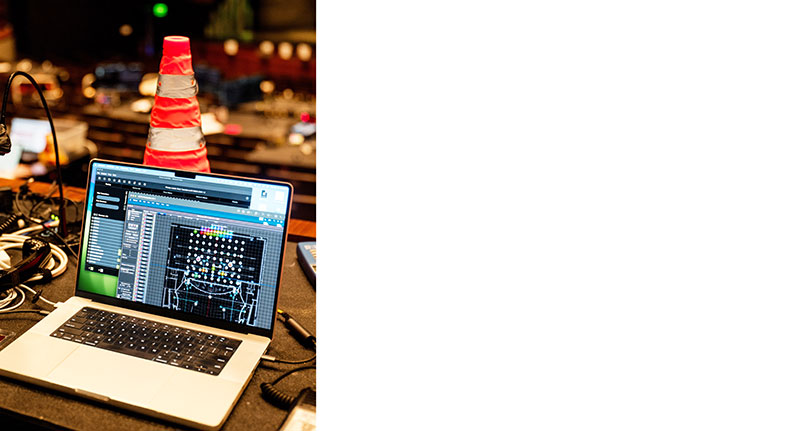
Meanwhile, for crew communication and spotlight monitoring, the theatre’s Clear-Com Arcadia intercom system was also integrated with Dante. Wavetool was routed through a Clear-Com Arcadia channel via Dante to focus on specific microphone issues while roaming. Backstage paging and lobby feeds were distributed across dedicated Dante channels as well.
The Dante infrastructure supported virtual soundcheck tasks by recording live inputs directly into a laptop and routing them back through the console for mix rehearsal. “If the cast isn’t in for 30 minutes, we can hit the button, play back the show audio, while the audio engineer can be mixing. It’s invaluable,” Anthony said.
Enveloping the Audience
Looked at from his role as lead sound designer, certain advantages from the system were seen immediately. The audience as well as Anthony’s colleagues noted the clear intelligibility of the sound, and the spatial realism. Their reactions weren’t confined to volume or audio precision but related to how the sound occupied the theatre space, enveloping the audience in a fully immersive experience.
In the company's earlier years, sound was the area that needed the most improvement. Among several other upgrades, implementing the spatial system has led to regular positive feedback, pointing to the importance of spatially accurate sound placement – something Dante-enabled networks have made possible.
The success of The Wizard of Oz demonstrated how a Dante-based ecosystem can lift theatrical sound to cinematic quality. As much as greater clarity, it has facilitated immersive design and rapid deployment.
Owing to Dante’s high channel count, low latency and precise synchronisation, Anthony’s team is able to place audio cues anywhere in the theatre with extreme accuracy, creating a three-dimensional sound field. This capability is especially valuable in large venues where audience members often experience sharply contrasting sound quality, depending on seat location. www.audinate.com