


Colorfront’s new workflow tools shown at IBC2026 feature automated timeline comparison, mastering support for Dolby Vision 2, AI-assisted QC tools and encrypted DCP cloud workflows.
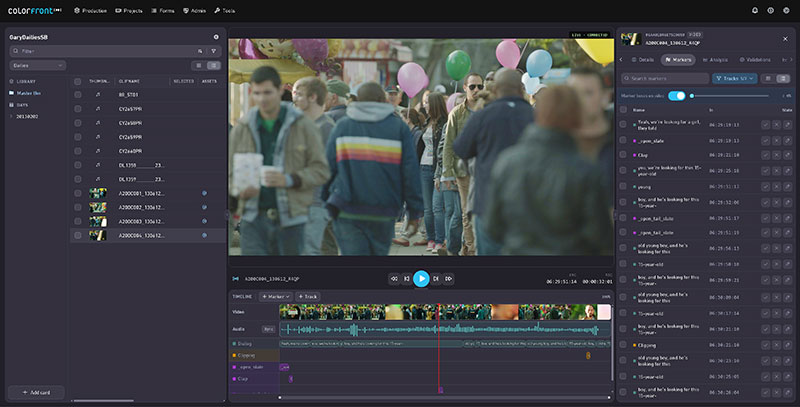
Bushido enterprise management
Colorfront announced and demonstrated its updated new workflow tools during IBC 2026 in Amsterdam. The main improvement is automated timeline comparison, developed to save time for users by finding all changes between two versions of a program in a few seconds. Colorfront has introduced mastering support for Dolby Vision 2, new AI-assisted QC tools and secure encrypted DCP workflows in the cloud, and has also redesigned their rendering architecture.
All changes have been built through the company's API-first architecture and can be used at any operational level, from manual mastering, to automation for high-volume projects, to AI-driven agents.
According to Mark Jaszberenyi, CEO of Colorfront, versatility is now essential to media workflows. “The same Colorfront engine now powers an operator keeping precise control over a mastering project, an automated QC pipeline running at scale, and an AI agent that configures analysis from a written spec. With modern AI coding assistants, building a custom pipeline no longer requires specialised engineering,” he said
Smart Timeline Comparison and Versioning
When a new version of a program arrives at a facility, someone on the team has to devote time to working out what has changed. Colorfront's new timeline comparison does this job automatically, using content analysis, vector embeddings and fingerprinting to detect matching, new, modified and omitted elements between two timelines loaded side by side.
Results appear as markers on both timelines, with dual and three-way difference views, one-touch A/B between versions and collapsible marker groups to keep long programs readable. The comparison can also run fully automated inside a pipeline, and the resulting metadata can be inspected in Transkoder, exported as a report, or passed to third-party systems for downstream processing.
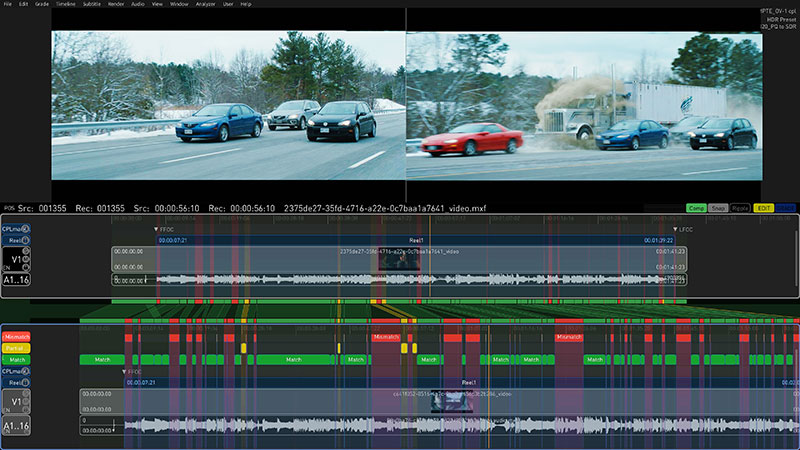
Timeline comparison engine
AI-Assisted Workflow Automation, QC and Analysis
At IBC, Colorfront showed previews of AI-agent-assisted workflow configurations, where an operator was handing the system a technical specification, such as the audio QC requirements for a streamer customer. An AI agent read the spec, configured the analysis, ran it and summarised the results. Because probing, validation and processing are all exposed through the API, facilities can build their conditional processing paths on standard automation platforms, and meanwhile, the AI coding assistants make these integrations much quicker to develop.
Cadence Detect automatically finds interlaced footage and retimed or duplicated frames anywhere in a timeline, and marks where each section starts and stops. The material can then be processed with Colorfront's de-interlacing, new NVIDIA-accelerated noise reduction and Super Resolution up-mapping and passed straight into the HDR mastering pipeline. This represents a single path from legacy source material to a modern HDR master.
New detection tools for burnt-in captions and text identify the texted sections of a master, pairs each with its corresponding textless element, and makes sure that they align precisely, down to single-frame discrepancies.
Loudness analysis now runs multiple measurement passes in parallel, allowing several delivery standards to be checked in one pass.
With custom marker schemas, users can define their own vocabularies and taxonomies – using fields such as severity, required action and assignee – resulting in a system where metadata matches each content owner's standards. Third-party QC data can be imported for centralised review, and Media Reports support custom company branding, logos and metadata.
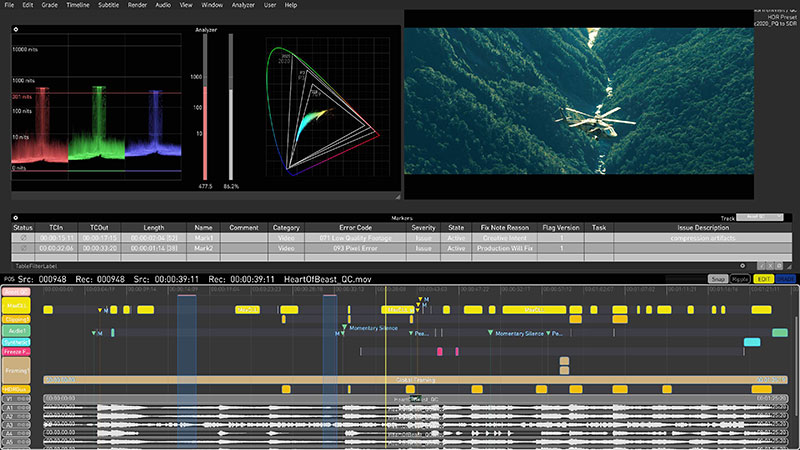
AI-assisted QC
HDR Mastering for Dolby Vision 2
Colorfront is the first mastering platform to support Dolby Vision 2, Dolby's most recent HDR format, as manufacturers and providers begin distributing it across displays and streaming services in 2026. With a new Dolby mastering node, operators can load, validate and adjust Dolby Vision metadata, including the Dolby Vision 2 parameters, before generating masters with updated XML output.
Colorfront has also added support for Amazon's new Dolby Vision IMF delivery specification and label-based audio mixdowns – which combine all the audio objects in a single audio file that occupies a single track.
Audio labelling tags speech and sound recordings with structured metadata. This process helps AI models learn to recognise and separate different acoustic events by identifying the source of the sound and the event that caused them. It makes it possible to automate speech recognition, differentiate between speakers in a recording (diarisation) and detect intent.
More Updates – Cloud Security, Scalable Rendering, Format Support
Persistent rendering – which allows an asset cache to persist while other unrendered assets are still being requested – and Linux-based workers distribute processing across available infrastructure, with a redesigned encoding page and new WebUI Render Page for submitting and tracking multiple jobs at once.
Format support now covers a new ProRes RAW processing node, the most recent Sony and Canon camera formats, and ASC FDL improvements for dailies and VFX teams. DCP validation reports are now more extensive and include bitrate graphs.
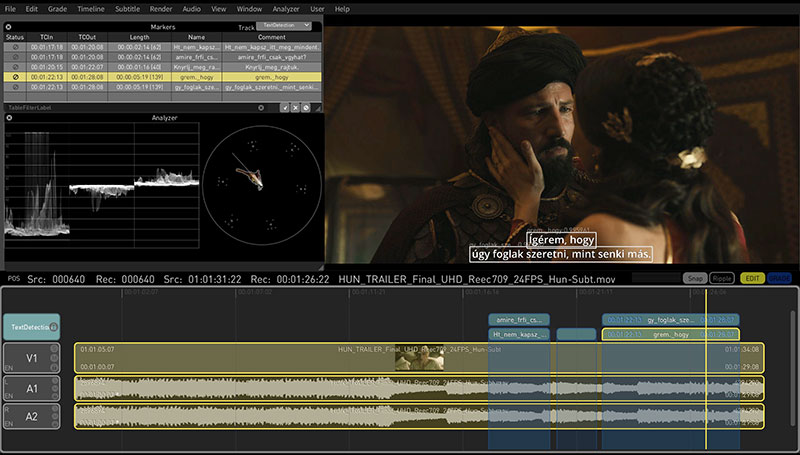
Automted Text Detection
Transkoder 2026 introduces Cloud DCI Key Management, carrying secure, encrypted DCP workflows to AWS. Instead of a machine-bound DCI certificate on every EC2 instance, Colorfront DataConnect manages access through DCI certificate groups whose private keys never leave AWS Key Management Service. Any number of Transkoder instances can open encrypted DCPs in a secure working group directly from Amazon S3 and deliver encrypted DCPs and KDMs at cloud scale.
Bushido Web-Based Enterprise Management
Colorfront is developing a web-based enterprise platform named Bushido that is currently in closed beta. Bushido centralises the management of complex media environments such as workflow automations, metadata review and editing, and verification of automated AI analysis. Operators can recall and override pipeline presets with a visual overview of LUTs, IDTs, framing and colour space conversions, and take live control of On-Set Dailies and Transkoder processing pipelines with streaming output for remote review. colorfront.com